Fire Buffs promote the general welfare of the fire and rescue service and protect its heritage and history. Famous Fire Buffs through the years include Edward VII.

Thursday, July 23, 2015

INVERGOWRIE BAY - 1979

Fire brigade at scene

On Oct. 22, 1979, an express plowed into a stalled train near Dundee, Scotland, killing five people and injuring 51 others in the Invergowrie rail disaster.

The Courier newspaper recalled on the 35th anniversary:

"
Dozens of police, firemen and paramedics fought through weeds and thick foliage to reach the wreckage at Dargie Glebe.

"They were then confronted with a scene of almost unimaginable horror.

"The two carriages that had landed on the wet sand of Invergowrie Bay were beginning to sink and passengers were frantically trying to smash windows and doors so they could escape.


"Ladders and ropes were used to reach the carriages and injured passengers.
"One of the first task medics had to carry out at the scene was to amputate the leg of a 74-year-old woman."

HYNDLAND SCHOOL - 1977


"There was a flashover."

On Oct. 12, 1977, flames destroyed Hyndland Secondary School, Glasgow.

The fire brigade contended with low water pressure.

The West End News reported: "T
he Water Board were carrying out work within the area" and "urgent requests were made to have the pressure increased."

Student
 Audrey Edmiston said: “When I arrived the roof was just falling in. There were sparks everywhere, and the smoke was thick and black.”

Another pupil, Catrina Campbell, said: "I witnessed the whole fire from the first moment we saw smoke coming from the top floor. I could feel the heat from the road below, and it was very spectacular when the windows blow out.”


In an account posted on the website Urban Glasgow, Michael Fleming, a fire officer assigned to the Knightswood Station firefighter, recalled "there was no sign of fire" on arrival.


"After about ten minutes of investigating inside the school a member of the public ran to the fire engine to inform us that smoke was coming from under the eaves of the roof on the far side of the school entrance.

"My crew of four men where sent to the roof void with a line of hose to attack the fire.

"When we got into the loft we spied the fire at the far end of the building and proceeded to drag our line of hose as near to the flames as we could when suddenly there was a flashover which cause us to exit the roof space as quickly as possible before it engulfed us all in flames

"The whole roof void was now an inferno.

"
This school was built in Victorian times and had lath and plaster walls and ceilings throughout which meant it had many nooks and crannies behind the walls and ceilings which allowed embers from the fire in the roof to drop to the ground floor inside the walls causing fires in classrooms all over the school.

"The speed at which this occurred was amazing. By this time there were many fire engines in attendance trying to save the school.

"
I remember my crew were fighting fires in classrooms all around us on the top floor when the water was cut off suddenly for about ten minutes.

"We retreated to the only classroom not involve yet in fire and waited in terror for the water to come back on again.

"That was the longest ten minutes of my life as we tried to think of some way to escape if the water was too late coming back on.

"
If I remember correctly workmen had been in the roof space with an acetylene cylinder working with tar before they went for their lunch that day."

GREENOCK BLITZ


On May 6 and May 7, 1941, German bombers targeted shipyards around the Scottish town of Greenock, killing 280 people and injuring more than over 1,200.

Bombs set ablaze 
Ardgowan Distillery on Bakers Brae and the flames acted as a beacon for waves of attackers.

In an oral history on the website Remembering Scotland at War, survivor 
Alex Hunter said:


"The east end of the town which had all the major industries, well there was a bomb fell, say the tanworks, the ladyburn engine sheds, Scott’s shipyard, both sugar refineries, Rankin and Blackmore’s and the distillery. These were major targets. And they hit them."


Margaret Chatters, another survivor, said:

"
The Westburn sugar house got a direct hit. Our house was damaged and all the windows blown out. My mother’s washing was out in the road."

For gallantry during the raid,
Firemaster A.S. Pratten, Sub-Station Officer William Neill and Fireman James Berry were awarded the George Medal.


The men entered a burning building and contained flames that threatened to destroy  material essential to the war effort, according to Wikipedia.


Firemaster's Report


Air Raid 6th May 1941

The Air Raid Warning “Red” was received at 00.49 and the Air Raid Message “White” at 03.25.

During the period of the raid 25 incidents were recorded at Headquarters.

These were expeditiously dealt with and with the exception of the undermentioned, presented no particular difficulty although serious damage was caused in several instances.

The most difficult fires to handle were at Belville St. (incident No.15) where, shortly after the arrival of the Brigade, a high explosive bomb destroyed the water main, (eliminating water pressure over a wide area), and the 5000 gallon steel dam provided for the area.

This circumstance necessitating relaying water from Victoria harbour, a distance of about half a mile.

The raid, although on a fair scale, was well within the scope of the local service.

A. S. Pratten
Firemaster
Fire Brigade Headquarters
Greenock
15th May 1941

Firemaster's Report provided to website Remembering Scotland at War by Graeme Kirkwood

Friday, September 19, 2014

EDINBURGH OLD TOWN - 2002


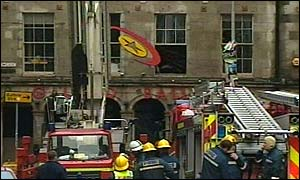
On Dec. 7, 2002, fire struck Edinburgh Old Town.

Flames started above a nightclub, the Belle Angele.

According to Wikipedia:

"The complicated nature of the buildings, with narrow alleys and entrances from the same building onto streets at different heights, complicated efforts to fight the fire."

Firefighers described it as a "rabbit warren."

Lothian and Borders Fire Brigade Divisional Officer David Young told the BBC: "A substantial part of the core of the heart of the Old Town of Edinburgh has been destroyed."


Images: BBC

GOVAN HIGH SCHOOL - 1962


Photos: acumfaegovan.com and Evening Times

Fire destroyed Govan High School in Glasgow on June 6, 1962. The blaze was deemed accidental. There were no serious injuries.


Thursday, September 4, 2014

CLARKSTON TOLL - 1971

UPDATED FEB. 13, 2018


Photo: BBC

On Oct. 21, 1971, a natural gas explosion at Clarkston Toll shopping center near Glasgow killed 22 people and injured more than 100 others. The smell of gas lingered in the days leading up to the explosion. Workers were unable to locate the source. Investigators determined a fractured and corroded pipeline fueled the explosion. Twenty fire engines responded as did all available Glasgow ambulances.

.....

We received the following from a reader in February 2018:


My name is John Brown and whilst searching for images of old fire appliances from the City of Glasgow Fire Service in Scotland I stumbled across your fire journals.
With reference to the Clarkston Explosion of 1971 I can vaguely recall it.  We lived at the other side of Glasgow and at the age of five my head was full of more important things like toys as well as what was for my dinner and the like.  Anyway, I knew something serious had occurred what with the TV news as well as the following days newspapers lying around.
Just recently STV broadcasted a short half hour documentary on it titled The Clarkston Explosion presented by the historian Fergus Sutherland as part of the series “The Peoples History Show.”  The key mains points were as follows:
The Clarkston shopping centre was constructed in 1965 with a rooftop car park and the old railway station to the rear.
An underground four-inch gas main ran the length of the shops separated from the legacy cellars by a four-foot bank of earth.
British (Scottish) gas were in the process of converting as well as replacing old systems to run on Natural Gas as opposed to what was referred to as “Town Gas.”  This program of conversion and/or replace took ten years to complete commencing in 1967 with its completion in 1977.  During this period British Gas shipped natural gas from the drilling rigs off the Northumbrian coast north prior to the Oil and Gas drilling platforms in the North Sea between the North East coast of Scotland and the coast of Norway coming on line.  Unfortunately, this program hadn’t reached Clarkston by this point.
An Emeritus Expert Professor Douglas Greenhaulgh from the Glasgow Caledonian University explained that Town Gas as opposed to Natural Gas was extremely flammable as well as Toxic which would explain why the persons in the shops adjacent to the ruptured gas main fell ill the day before the explosion.
He continued to explain that Town Gas was a combination of Hydrogen, Carbon Monoxide and Methane.  A smell of gas had been reported a few days prior to the explosion unfortunately during this period the gas percolated through the earth banking into the legacy cellars beneath the shops where it had built up.  He went on to say that at the time of the explosion it would’ve probably have been estimated that the force of the blast would have been equivalent 300lbs of TNT going off.  

PRINCE'S DOCK - 1960


“Everything appeared normal for about three minutes. Then, suddenly, we all started collapsing. It just hit us.”

On Dec. 2, 1960, Station Officer Douglas Mearns of the St. Mungo fireboat died battling a fire in the hold of the German freighter M.V. Pagensand at Prince's Dock, Govan.

Eleven other firemen and a dock worker were overcome by fumes.

The firemen were wearing breathing apparatus and “went down like ninepins without warning,” Glasgow Firemaster Martin Chadwick told reporters.


The vessel carried matches, wood pulp and paper.

Berhold Schlinder, master of the Pagensand, said the fire was discovered at sea and that the cargo continued to smolder after the crew sealed the hatches and vents.